The Collaborative Editor by Christine Steele and Lourdes Venard

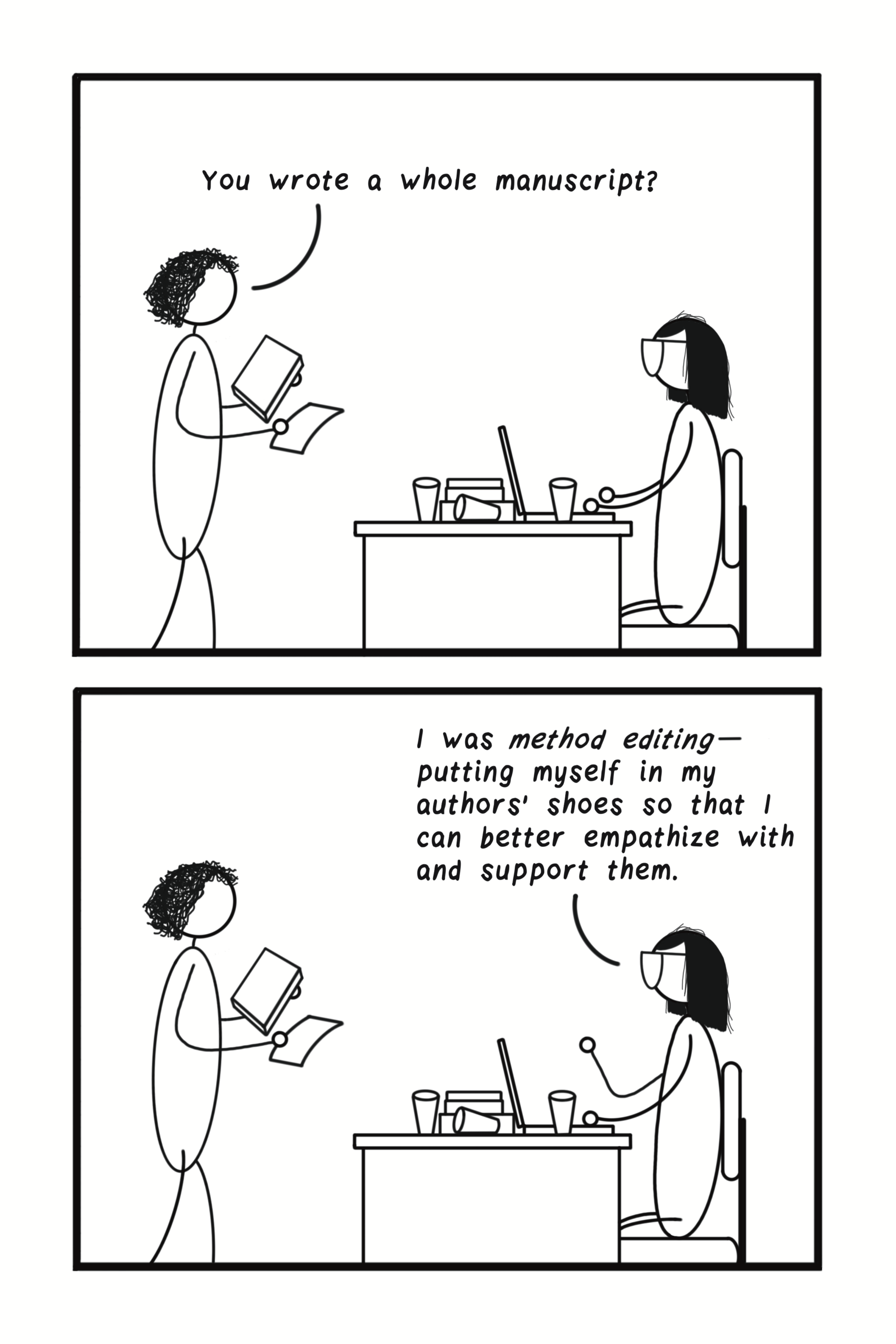
Two-frame cartoon. Frame 1: Curly-haired editor is flipping through a stack of paper and says to Bespectacled editor, sitting at her desk, “You wrote a whole manuscript?” Frame 2: Bespectacled editor says, “I was *method editing*—putting myself in my authors’ shoes so that I can better empathize with and support them.”

In 2025, fellow editors Christine Steele and Lourdes Venard asked me if I’d be interested in contributing a few cartoons to their upcoming book. I got to read an early draft of what became The Collaborative Editor and appreciated their approach to cultivating mutually respectful professional relationships between editors and authors through clear and tactful communication. They recently published a blog post detailing their journey from editors to published authors.

This cartoon is one of three that will appear in their book, which is now available for preorder. In lieu of accepting a fee for this commissioned work, I asked for a donation to the Qajuqturvik Community Food Centre, which I’m grateful to the authors for making.

The Collaborative Editor: How to Build Trust with Writers Through Queries and Other Communications will be published by the University of Chicago Press in spring 2027. Thanks, Christine and Lourdes, for inviting me to be a part of it!

Creative Commons License

The plain language movement in Canada, 1980–1995: An oral history

Four-frame cartoon: Frame 1: Bespectacled editor says to curly-haired editor, “Heh. You ever procrastinate on something for nine years, and then when you finally get to it, it takes just a few months?” Frame 2: Curly-haired editor says, “I’m sorry… Did you say NINE YEARS?” Frame 3: Bespectacled editor stares straight ahead in silence. Frame 4: Bespectacled editor looks down in shame.
Creative Commons License
In 2017, in the middle of my PhD program, I embarked on a little side project to interview leaders of the plain language movement in Canada who were active between 1980 and 1995. I chose that window because it’s within what my former publishing prof John Maxwell called the internet’s historical rain shadow: not old enough to be considered interesting and thus worthy of being documented online but not new enough that it would automatically exist online. Without a concerted effort to fill that gap in our history, information about those events could be lost forever. Continue reading “The plain language movement in Canada, 1980–1995: An oral history”